
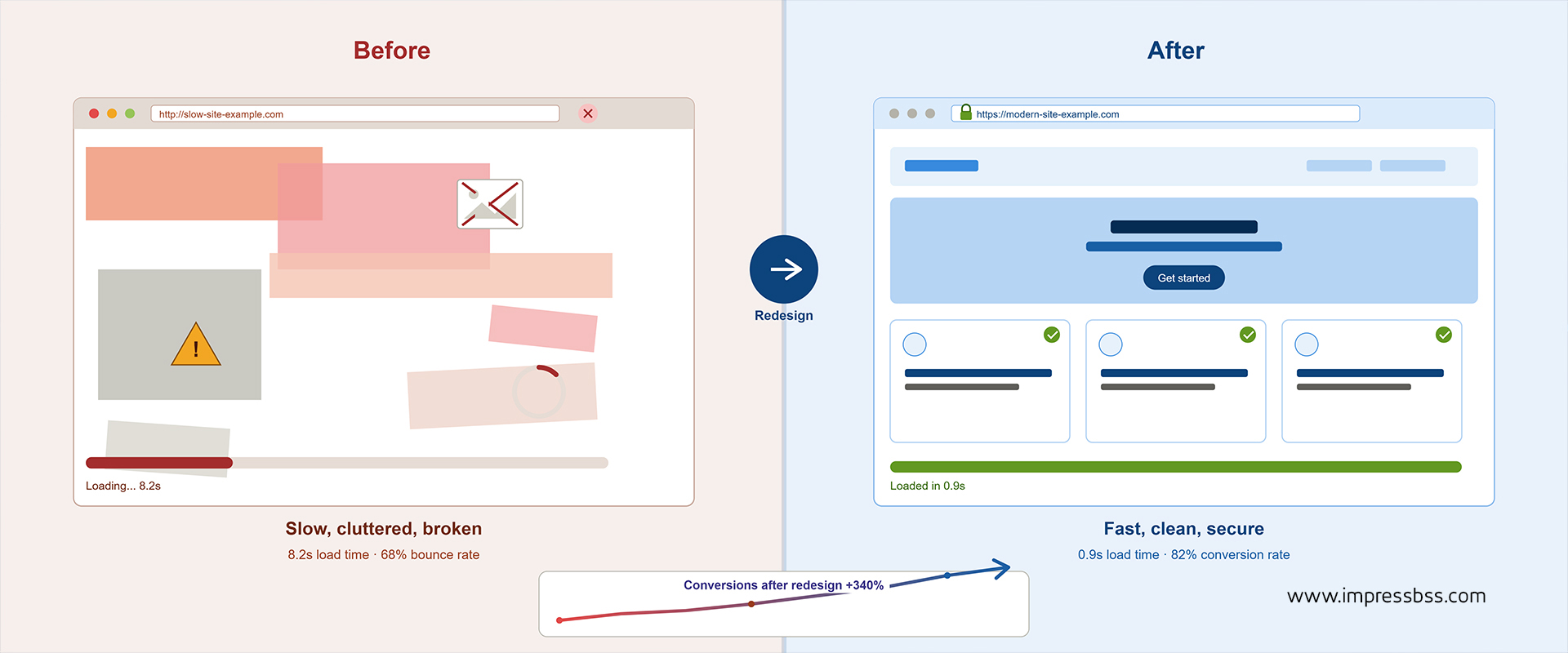
Website Design Trends 2026 15 Modern Features Every Business Website Needs
If you've looked at your website lately and felt like something's... off, you're not imagining it. The web moves fast, and what looked "modern" even two years ago can feel dated today. Whether you run a startup, manage a hospital's online presence, oversee admissions for a school, or handle marketing for a manufacturing unit, your website is often the very first conversation you have with a potential customer, patient, student, or partner.
And in 2026, that conversation needs to be sharp, fast, secure, and genuinely helpful — not just pretty.
This guide walks you through why website design matters more than ever this year, the 15 trends actually shaping business websites right now, the mistakes that quietly kill conversions, and answers to the questions business owners ask us most often. No jargon overload, no fluff — just practical, real-world guidance you can act on.
Why Website Design Matters in 2026
Let's get one thing straight: your website is no longer just a digital brochure. It's your salesperson, your receptionist, your customer support agent, and your brand ambassador — all rolled into one, working 24/7 without a lunch break.
Here's why design decisions carry more weight than ever this year:
People judge you in milliseconds. Research on first impressions has consistently shown that visitors form an opinion about a website's credibility in under a second. A cluttered layout, a slow-loading page, or outdated visuals can send someone straight to a competitor before they've even read a word of your content.
Google's algorithms reward genuine quality. Search engines have gotten remarkably good at understanding user experience signals — how fast your site loads, how easy it is to navigate, and whether people actually stay and engage. Good design isn't just about aesthetics anymore; it directly affects your search rankings.
Mobile isn't an afterthought — it's the main event. More people browse, research, and even complete purchases on their phones than on desktops. A website that isn't built mobile-first is a website that's actively losing business.
Trust is harder to earn and easier to lose. With rising awareness of scams and data breaches, visitors are more cautious than ever. Security badges, clear privacy policies, and a professional look aren't nice-to-haves — they're deal-breakers if missing.
Every industry is affected. A hospital website needs to reassure anxious patients. A manufacturer's website needs to demonstrate technical credibility to B2B buyers. An educational institution's website needs to feel trustworthy to parents. A startup's website needs to look established enough to win its first big client. Design isn't cosmetic — it's strategic.
With that foundation in place, let's get into the 15 trends actually shaping business websites this year.
15 Website Design Trends Businesses Need in 2026
1. AI-Powered Websites
Artificial intelligence has moved from "cool add-on" to "expected feature." Businesses are now using AI in ways visitors barely notice but deeply feel:
- Smart chatbots that actually understand context and answer real questions instead of looping visitors through canned responses
- Personalized content that shows different homepage messaging based on visitor behavior, location, or industry
- AI-assisted search on the website itself, so users can type a natural question and get relevant results instantly
- Predictive recommendations, similar to what e-commerce giants use, now scaled down for small and mid-sized business sites
For a hospital, this might mean an AI assistant that helps patients find the right department. For a manufacturer, it could mean a smart product finder that narrows down specifications in seconds. The point isn't to slap AI everywhere — it's to use it where it genuinely reduces friction for the visitor.
2. Mobile-First Design
This isn't new advice, but in 2026 it's non-negotiable. Mobile-first design means your website is designed for small screens first, then scaled up — not the other way around.
What this looks like in practice:
- Thumb-friendly navigation and buttons
- Fast-loading images optimized for mobile networks
- Forms that are short and easy to fill on a touchscreen
- Click-to-call buttons for service businesses, clinics, and hospitals
- Layouts that don't require pinch-zooming to read text
If your analytics show even 50% of traffic coming from mobile (and for most businesses today, it's closer to 60-70%), your design priorities should reflect that reality.
3. Voice Search Optimization
With voice assistants built into nearly every phone and smart speaker, more people are searching by simply asking a question out loud — "best pediatric hospital near me" or "affordable ecommerce website development in Chennai."
To optimize for voice search:
- Write content in a natural, conversational tone (like this blog!)
- Target long-tail, question-based keywords
- Create FAQ sections that directly answer common spoken queries
- Ensure your Google Business Profile is accurate and complete, since voice search often pulls local results
- Use structured data (schema markup) so search engines can easily parse and read your answers aloud
Voice search optimization is especially valuable for local businesses, clinics, and service providers where "near me" searches are common.
4. Interactive UI/UX
Static, text-heavy pages don't hold attention the way they used to. Interactive elements keep visitors engaged and help them understand your offering faster:
- Hover effects and micro-animations that provide subtle feedback
- Interactive product configurators (great for manufacturers and e-commerce brands)
- Scroll-triggered animations that reveal content progressively
- Quizzes or calculators (like a "get a rough project quote" tool)
- Interactive maps for hospitals or campuses with multiple locations
The goal isn't to add animation for its own sake — over-designed pages can actually hurt usability. The goal is purposeful interactivity that guides the visitor toward the information or action they need.
5. Core Web Vitals & Site Speed
Google's Core Web Vitals measure real-world user experience: how fast your page loads, how quickly it becomes interactive, and how stable the layout is while loading. These metrics directly influence your search rankings in 2026.
The three pillars to focus on:
- Largest Contentful Paint (LCP): How fast the main content loads — aim for under 2.5 seconds
- Interaction to Next Paint (INP): How responsive your site feels when someone clicks or taps
- Cumulative Layout Shift (CLS): Whether elements jump around while the page loads (frustrating for anyone trying to click a button)
Practical steps: compress images, use a reliable hosting provider, minimize unnecessary scripts, and choose a lightweight, well-coded theme or custom build rather than a bloated template packed with unused features.
6. Website Security
Security is no longer just an IT concern — it's a design and trust concern. Visitors, especially on hospital, educational, and e-commerce websites, want visible reassurance that their data is safe.
Key elements for 2026:
- SSL certificates (the padlock icon) as a baseline, not a bonus
- Clear privacy policies written in plain language
- Secure payment gateways with visible trust badges for e-commerce sites
- Regular security updates and malware scanning, especially for WordPress websites
- Two-factor authentication for admin and patient/student portals
For hospitals and educational institutions handling sensitive personal data, compliance with data protection regulations isn't optional — it's foundational to trust.
7. Dark Mode & Adaptive Themes
Dark mode has grown from a niche preference to a mainstream expectation, particularly for SaaS products, portals, and content-heavy sites. Offering a toggle between light and dark themes shows attention to user comfort and modern design sensibility, especially for platforms visitors use for extended periods, like patient portals or learning dashboards.
8. Minimalist, Content-First Layouts
Cluttered websites overwhelm visitors. The trend in 2026 leans toward generous white space, clear typography hierarchy, and content that's scannable at a glance. This is especially important for manufacturers and B2B companies whose visitors are often researching under time pressure and need to find specifications or contact details quickly.
9. Video and Motion-Based Storytelling
Short, purposeful video content — a founder introduction, a facility walkthrough for a hospital, a product demo for a manufacturer — builds trust faster than paragraphs of text ever could. Embedding lightweight, optimized video (not autoplay with sound, which frustrates users) is now a standard feature on high-performing business homepages.
10. Accessibility-First Design (WCAG Compliance)
Designing for accessibility means your website works well for people with visual, auditory, motor, or cognitive disabilities — through proper color contrast, alt text for images, keyboard navigation, and screen-reader compatibility. This matters ethically, legally (many regions now enforce accessibility standards), and practically, since accessible sites tend to rank better and reach a wider audience.
11. Micro-Interactions
Small design details — a button that subtly changes color on hover, a success checkmark animation after form submission, a progress bar during checkout — make a website feel polished and responsive. These micro-interactions might seem minor, but collectively they shape how "trustworthy" and "professional" a brand feels.
12. Personalized User Journeys
Websites in 2026 increasingly adapt based on who's visiting. A returning visitor might see different content than a first-time one. A visitor from a specific region might see localized offers or contact information. For educational institutions, this could mean tailoring content for prospective students versus parents versus alumni — all from the same homepage.
13. Sustainable and Ethical Web Design
More businesses are paying attention to their website's environmental footprint — optimizing code and media to reduce server energy consumption, and being transparent about data practices. This "green web design" trend resonates strongly with younger, values-driven audiences and adds another layer of brand credibility.
14. Headless & Composable Architecture
For growing businesses — especially e-commerce brands and multi-location institutions — headless CMS architecture (separating the front-end design from the back-end content management) offers flexibility, faster performance, and easier scaling across web, mobile apps, and other digital touchpoints.
15. Data-Driven, Conversion-Focused Design
Design decisions in 2026 are increasingly backed by real user data — heatmaps, session recordings, and A/B testing — rather than guesswork. Smart businesses continuously test button placements, headlines, and form lengths to improve conversions, treating the website as a living, evolving asset rather than a one-time project.
Common Website Design Mistakes to Avoid
Even with the best trends in mind, plenty of businesses undo their own progress with avoidable mistakes:
- Ignoring mobile users. A desktop-only mindset alienates the majority of your visitors.
- Slow load times. Every extra second of load time increases the chance a visitor leaves before your content even appears.
- Overloading pages with pop-ups. Aggressive pop-ups frustrate users and hurt both usability and search rankings.
- Outdated content. Old blog posts, expired offers, or last year's team photos quietly damage credibility.
- No clear call-to-action. If visitors don't know what to do next — call, book, buy — they simply leave.
- Skipping security basics. No SSL certificate or visible security signals is an instant trust-killer, especially for healthcare and e-commerce sites.
- Overusing trendy effects. Heavy animations without purpose can actually slow the site down and confuse navigation.
- Neglecting accessibility. Excluding users with disabilities isn't just a missed audience — in many regions, it's a compliance risk.
- Inconsistent branding. Mismatched fonts, colors, and tone across pages make a business look unpolished and unreliable.
- Not testing across devices and browsers. What looks perfect on your laptop might break entirely on someone else's phone.
Avoiding these pitfalls is often just as important as adopting the latest trends — sometimes more so.
How to Apply These Trends to Your Business
You don't need to implement all 15 trends overnight. Here's a practical approach:
- Startups: Prioritize mobile-first design, speed, and a clean, trustworthy first impression to compete with bigger, established brands.
- Hospitals & clinics: Focus on accessibility, security, AI chat support for patient queries, and fast-loading pages for people searching urgently.
- Educational institutions: Emphasize clear navigation, video storytelling, and personalized journeys for students versus parents.
- Manufacturers: Lean into minimalist, content-first layouts, interactive product tools, and strong Core Web Vitals to support B2B research behavior.
- SMEs & local businesses: Voice search optimization and local SEO-friendly design will matter more than flashy animations.
Whatever your industry, the underlying principle is the same: design for your actual visitors, not just for what looks impressive in a portfolio.
If you're evaluating whether to build a fresh site, upgrade an existing one, or move to a more flexible platform, working with an experienced web design company in Chennai can help you figure out the right approach for your budget and goals. Depending on your needs, that might mean a static website design for a simple, fast-loading brochure site, a more robust dynamic website development solution for a business that needs regular content updates, a WordPress website design for flexibility and ease of management, or full ecommerce website development if you're ready to sell online.
FAQs
1. What is the biggest website design trend for 2026? AI-powered personalization and mobile-first design are arguably the two biggest shifts, since they directly affect how visitors experience and interact with a website.
2. Do small businesses really need all these features? Not all at once. Focus on the fundamentals first — mobile-first design, speed, security, and clear navigation — then layer in advanced features like AI chat or personalization as your business grows.
3. How does website design affect SEO rankings? Design directly impacts Core Web Vitals, mobile usability, and user engagement signals — all of which search engines factor into rankings. A well-designed site isn't just easier to use; it's also easier to find.
4. Is dark mode really necessary for a business website? It's not mandatory, but it's a strong nice-to-have for content-heavy platforms or portals where users spend extended time, as it improves comfort and signals modern design thinking.
5. How often should a business redesign its website? Most businesses benefit from a substantial design refresh every 2-3 years, with smaller updates (content, images, small UX tweaks) happening continuously in between.
6. Is WordPress still a good choice for businesses in 2026? Yes, especially for businesses that need flexibility and frequent content updates. A well-optimized WordPress website design can absolutely keep pace with modern design trends when built correctly.
7. What's the difference between a static and dynamic website? A static site has fixed content and is typically faster and simpler — ideal for smaller businesses with straightforward information. A dynamic site pulls content from a database and updates more easily, better suited for businesses that publish frequently or need interactive features. Learn more in our static website design and dynamic website development guides.
Website design in 2026 isn't about chasing every shiny new trend — it's about building a site that genuinely serves the people who visit it: faster, more secure, more accessible, and more helpful than it was last year. Whether you're a hospital reassuring anxious patients, a manufacturer proving technical credibility, an educational institution building trust with parents, or a startup trying to make a strong first impression, the principles are the same — put the visitor's experience first, and the results (rankings, trust, conversions) tend to follow.
If you're planning a redesign or building your first business website, it helps to work with a team that understands both design and the technical fundamentals behind it. Explore our related guides for deeper insight: our Website Cost Guide to understand budgeting, our Responsive Website Guide for mobile-first best practices, and our Website Mistakes Guide to avoid common pitfalls before they cost you visitors.
A great website isn't a one-time project — it's an ongoing investment in how your business shows up in the world. Start with the fundamentals, adopt trends that genuinely fit your audience, and keep refining as you go.